
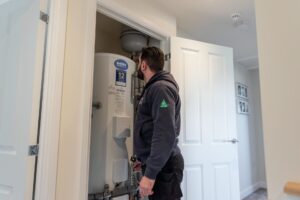





It can be pretty frustrating to wake up to a cold house, or to only get freezing cold water from the hot tap. You go down to check the boiler and sure enough, there’s that annoying flashing light or error message on the display. Yes – your boiler has tripped, and you’re locked out.
Before you get too concerned, it’s worth knowing that this annoying event could have saved you a lot of money, and possibly even saved your life. That’s because boilers are designed to switch themselves off whenever they detect something is outside of the safe operating thresholds. There could be an issue with the water, the gas, the flame, the vent or the flue – and your boiler has just let you know about it.
And yes, sometimes they do get a little needy, and switch themselves off for apparently no reason, for example a temporary drop in pressure. Even if the underlying issue solves itself, there’s a good chance that the boiler will remain tripped out until you physically reset it. Again, quite annoying, but better safe than sorry.
In this article, we’ll look at what the most common causes of boiler lockout are. Sometimes, you can solve the issue that’s causing the error message yourself with a little knowledge. Other times, you’ll need to call a professional Gas Safe engineer to come and have a look at your boiler and possibly your whole central heating system.
What is boiler lockout and why does it happen?
Your boiler is a complex piece of machinery, full of valves, pumps, pipework, electronics and other vital components. Considering how much punishment we put them through twelve months of the year, they’re surprisingly robust and dependable appliances. But inevitably, things do sometimes fail.
All around your boiler, there are sensors measuring temperature, pressure, flow and such like, and electronic circuits designed to make sure everything is operating as it was designed to do. It only takes one of these sensors to detect that something has exceeded its safe limits, and the whole boiler will be shut down. That should stop the situation from getting worse. As with all good safety devices, they are designed to trip while the components are still within their safe limits, not beyond them. That’s why they might sometimes seem a bit sensitive.
The telltale sign of a boiler lockout is some kind of indication that the boiler is tripped. Depending on the make and model, that could be a light (flashing or permanently on), or some kind of error message on the digital display. In a way, it’s quite reassuring to see this, as it shows the boiler has shut itself down rather than simply being broken.
Common causes of boiler lockout
Now, we’ll go through the various reasons why the boiler might lock you out. We’ll say whether it’s possible that you could remedy it, or whether you need to call in the professionals.
Low boiler pressure
Perhaps the most common cause for a boiler to trip is low water pressure. The boiler and your central heating need a certain amount of pressure (usually 1–1.5 bar when cold) to operate efficiently. The colder it is, the lower the pressure will be, so if it’s particularly cold in the home, there’s a chance that your pressure has dropped below safe levels. That can easily happen if the pressure was at the lower end of the range when the heat was turned on.
There should be a pressure gauge on the front of your boiler (you may have to lift a panel to see it). It will either be a digital display (LED or colour screen), or perhaps a physical gauge with a needle. Modern boilers with detailed displays might tell you the exact problem, but older ones might just have an error code, which you’ll need to look up in the manual. Whatever the type of display, if the pressure is below 1 bar, you’ve probably found the answer – you need to put more water in the boiler using the filling loop until it’s back to the proper pressure.
High pressure
The opposite problem is high pressure, which is usually caused by overfilling the loop. The easiest way to cure this is to bleed a radiator, but only do this if you know that you’ve accidentally overfilled it. If there’s high pressure out of the blue, you’ll need a professional to inspect the boiler.
Frozen condensate pipe
The condensate pipe takes waste water away from the boiler and deposits it outside. However, if it’s freezing outside, it can get blocked with ice. The best way to resolve this is to pour warm (not boiling) water on the pipe. It’s usually a plastic or copper pipe coming out of the outside wall opposite where the boiler is. In rare cases, it can be blocked by other objects, but this isn’t usually something you can tackle yourself – you might end up shoving it deeper in. Call a boiler engineer, who will be able to sort it out.
Ignition failure
Your boiler will constantly be switching itself on and off, even when it’s not technically in use. Older boilers had an always-on pilot light, but modern ones use an electronic ignition system, which does sometimes fail. If the boiler is supposed to be on but there’s no flame, it will switch itself off.
You might hear a constant clicking as it tries to light, but it will switch off eventually. This is definitely a job for a professional. It could be the ignition system itself, or there could be a problem with your gas supply.
Overheating/thermostat issues
If the boiler is running too hot, it will shut itself down. This could be down to a number of reasons, such as the pump not working properly, a blockage in the heat exchanger or a faulty thermostat. There’s nothing a regular householder can do here – it needs professional attention.
Blocked flue
The flue takes all the harmful exhaust gases out of the home once the gas has been burned. It is absolutely critical that this gas is not allowed to get into the enclosed space of the home, so if the boiler detects a blockage in the flue, it will shut down. Check the flue for buildups of snow, leaves or even a bird’s nest – they can all stop the flow. If there’s nothing immediately obvious, call an engineer.
Air in the system
Bubbles can build up in the water loop, and it will affect the flow, pressure and temperature. It can often happen after there has been a repair, but it can just happen organically over time. Try bleeding a few radiators to expel trapped air.
Faulty components
If the system detects an important fault in any of the critical components, the boiler will shut itself down. Call your local Gas Safe engineer to perform any repairs or replacements.
Firing it up again
It’s always worth trying to fire up the boiler once it has locked you out. As we mentioned above, some issues are fleeting, and don’t indicate an underlying issue. If you’ve just repressurised it after low pressure, you should be safe to start it up again.
All brands and models have their own specific ways of starting up. Some might do it automatically, for example when it detects that the pressure has returned to normal levels. Others will need to be manually started. Check your boiler’s manual for specific instructions.
If you try two or three times, and the boiler doesn’t start, or if it trips out again shortly after, don’t keep on trying. There is an underlying issue that needs addressing. It’s time to call a professional boiler engineer. If you’re in or around Milton Keynes, that means Able Plumbing Solutions!