
If your boiler is overheating, it isn’t something you should ignore. An overheating boiler can be both dangerous and damaging to your heating system, possibly leading to costly repairs or even complete system failure.
The good news is that modern boilers are equipped with sensors and switches that should shut the system down before serious damage occurs, but understanding why your boiler is overheating and taking the right action is still important.
In a nutshell, boiler overheating occurs when the water temperature within the system exceeds safe operating levels, which typically means around 100 °C. When this happens, your boiler’s safety systems should kick in, shutting down the unit to prevent damage or a dangerous pressure build-up. However, repeated overheating cycles suggest there could be an underlying problem that requires professional attention.
The commonest causes of boiler overheating
If you know what you’re looking for, you might get a better understanding of what’s wrong with your boiler. We can’t stress enough, however, that any serious diagnosis and work must be carried out by a qualified Gas Safe engineer.
Blocked or restricted water flow
One of the most likely causes of boiler overheating is water circulation being somehow restricted inside the system. When hot water cannot flow freely through the heat exchanger and around your heating circuit, it slows down and lingers over the flame for longer. The net result is overheated water.
This restriction often occurs due to limescale buildup, and that’s particularly relevant in hard water areas. That happens when minerals in the water form crusty, rock-like deposits that effectively narrow the pipes and reduce flow rates. Sludge from corrosion can also create blockages that prevent proper circulation.
The heat exchanger is particularly vulnerable to scaling and blockages. It’s where the boiling hot water that has passed over the flame crosses paths with fresh water from the mains, and it’s full of small pipes or vanes with narrow gaps between them. Any restriction here can quickly lead to blockages and overheating.
Faulty pump
Your boiler’s circulation pump is responsible for moving heated water around your heating system. If it begins to fail or starts running inefficiently, water movement slows down, causing hot water to remain in the heat exchanger or over the flame for longer than it should.
Pump problems can develop gradually, with the unit becoming progressively less effective over time. You might notice that some radiators heat up more slowly than others, or that certain areas of your home don’t warm up properly. These are often signs that the pump is struggling to circulate the water quickly enough. Pump failures can be from wear and tear, electrical faults or damage caused by sludge and limescale.
Thermostat and control problems
Faulty thermostats and control systems can cause your boiler to continue heating water beyond the set temperature. When temperature sensors malfunction or control circuits fail, the boiler may not receive the signal to reduce heat or shut down when the chosen temperatures are reached.
This can include problems with the boiler’s internal thermostat, room thermostats or the electronic control systems found inside the boiler. These control systems are complex and require professional equipment to test and repair properly. Usually, if the thermostat stops working properly, other safety systems will activate themselves to keep the system safe, but it still needs fixing.
Blocked flue or ventilation issues
Your boiler needs proper ventilation to operate safely. If your boiler’s flue becomes blocked or damaged, it might not be able to expel waste gases effectively. This can cause heat to build up within the boiler casing, leading to overheating. Flue and ventilation problems are particularly serious as they can also lead to a dangerous carbon monoxide build-up. If you suspect flue issues, you should immediately call a Gas Safe registered engineer.
Oversized boiler for your property
Sometimes overheating occurs because the boiler is simply too powerful for your home’s needs. An oversized boiler heats water too quickly, as the water returning to it might still be hotter than it should be. This problem is usually the result of poor initial sizing calculations during installation, but if you’ve had changes to the home (e.g. removed radiators), a similar thing can happen.
What you can check safely
Whilst most overheating problems require professional diagnosis and repair, there are a few things you can check safely as a homeowner.
Check your radiators
Feel your radiators to see if they’re heating evenly. Cold spots, particularly at the bottom of radiators, might indicate circulation problems or sludge buildup. If multiple radiators aren’t heating properly, this could suggest a wider circulation issue that might be contributing to overheating.
Monitor your boiler pressure
Keep an eye on your pressure gauge. Very low pressure can affect circulation and contribute to overheating, whilst very high pressure might indicate other system problems. Your boiler manual will tell you the correct operating pressure range.
Listen for unusual noises
Pay attention to sounds your boiler makes during operation. Kettling sounds (similar to a kettle boiling) often indicate scale buildup on the heat exchanger. Banging or gurgling noises might point to circulation problems or air in the system.
Check error codes
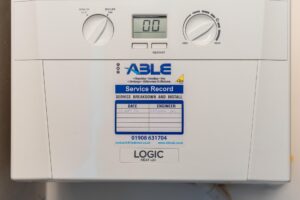
Modern boilers display error codes when problems occur. Make a note of any codes and how often they occur, as this information will be valuable for a heating engineer diagnosing the problem.
Simple preventative measures
Several straightforward steps can help prevent overheating problems from developing.
Annual boiler servicing
Stick to your 12-monthly service schedule. This should identify any potential overheating issues before you would notice them.
System power flush
Periodic power flushing removes sludge and scale deposits that can restrict circulation and cause overheating. It’s a professional cleaning process that should be carried out by qualified engineers using specialised equipment.
Water treatment
In hard water areas, consider installing a scale inhibitor or water softener to reduce limescale. Magnetic filters can also help capture system debris before it causes blockages.
Radiator maintenance
Bleed your radiators regularly to remove trapped air that can affect circulation. However, if you need to bleed radiators frequently, this might indicate a more serious system problem requiring professional attention.
Call the Milton Keynes boiler experts
If you’re in the Milton Keynes area and want someone to pop in and see why your boiler is overheating, contact Able Plumbing Solutions today. We have the expertise and the equipment to safely diagnose and fix any boiler issue.